EM Documentation. Fixed.
Hit record. See your patients like you already do. Sampson writes a complete ED note—yes, the whole thing. Paste it into your EMR. Done.
You didn't train this long to spend a third of your shift on documentation. Neither did we.
You can run a complex resus. You can nail a difficult airway. You're not the problem. This job has turned us all into the world's most over-qualified data entry clerks.
All the greedy corporate solutions out there just took the scribes they already built for primary care clinic, slapped an “EM Template” on them, and tried to pass them off as legit solutions. We know. We tried them. They sucked. So we built an ER-Native Scribe.
Three steps. That's it.
Record in the mobile app. Then, on your work computer, open sampsonscribe.ai, copy the note, and paste it into your EMR.
Record on your phone
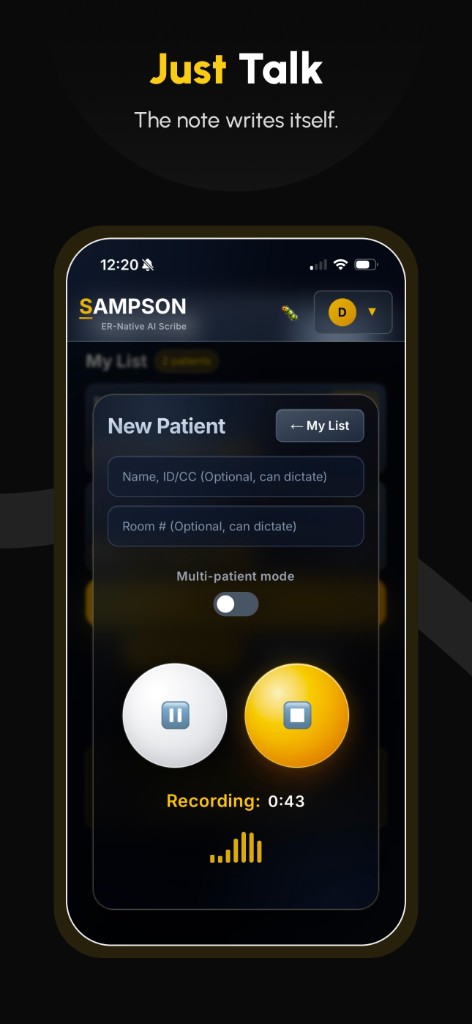
In the Sampson app. See patients the way you already do. Dictate exam and results like you're signing out to a colleague — no dictaphone phrasing.
Note is ready
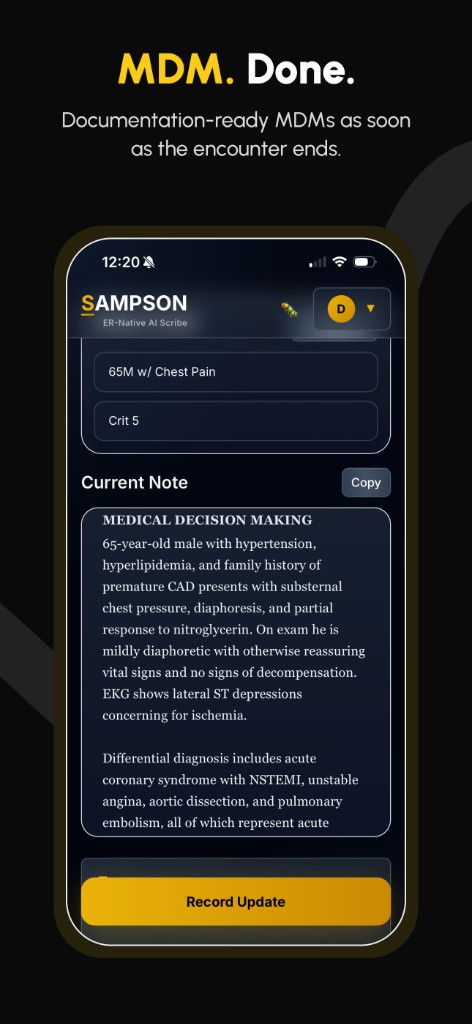
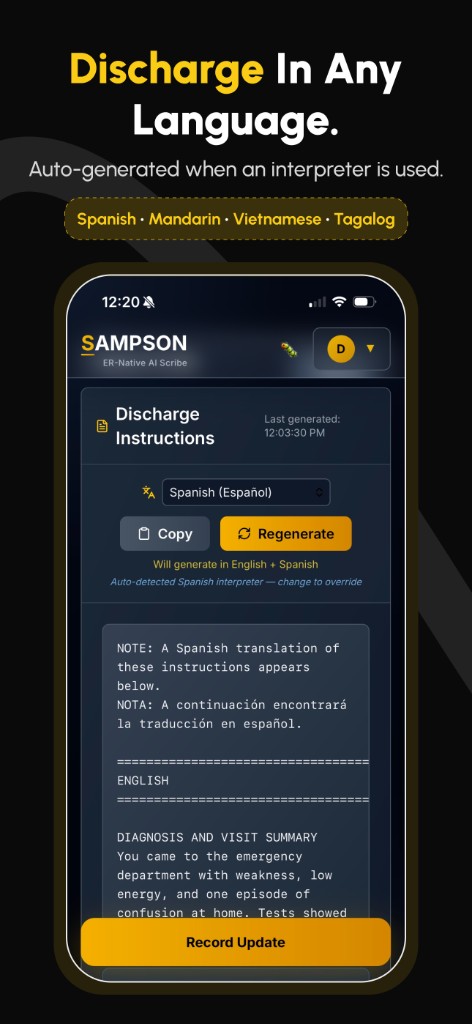
Full ED note on your phone — chief complaint through MDM, plus DC instructions. Multiple languages.
Paste on your computer
At your workstation, sign in at sampsonscribe.ai, copy the note, paste it into your EMR, and sign.
No more dreading having not started any notes yet. No more rushed DC instructions. No more charting after shift. Less burnout.
Built for the way shifts actually go.
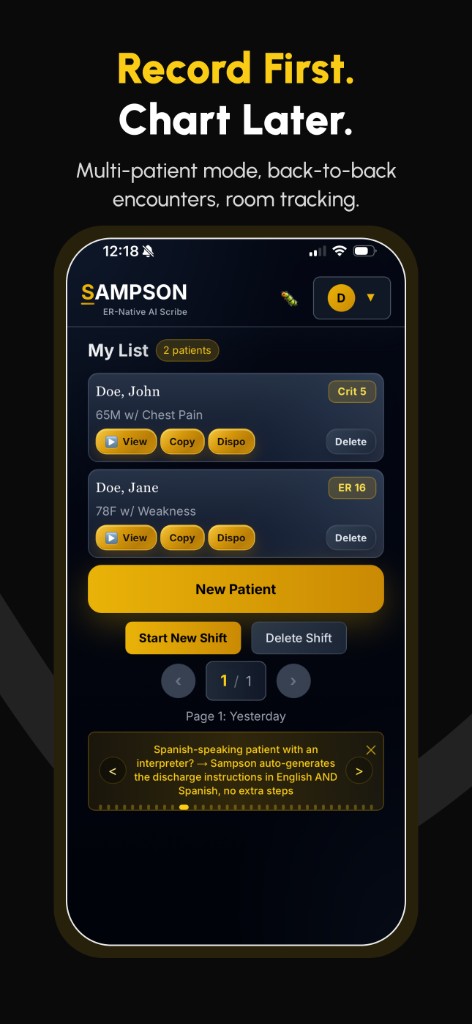
See four patients back to back. Pick up a 2-fer, then a 3-fer. Sampson keeps them straight — no stopping to close one out, no starting a new session, no additional steps.
And when your residents hit you with seven patients in the first ten minutes of a shift, you don't chart seven times. One stream of consciousness into your phone and you've got seven attestations — paste them right there, or update them after you've actually seen the patient.
No clinic scribe does this. They were built for one room, one patient, one note. This is what “built for emergency medicine” actually means.
See it in action.
Great notes. Paid correctly. Decisions defended.
Notes that pay today and have your back tomorrow.
These notes are legitimately good
And done before your orders are in.
Get paid for the work you did
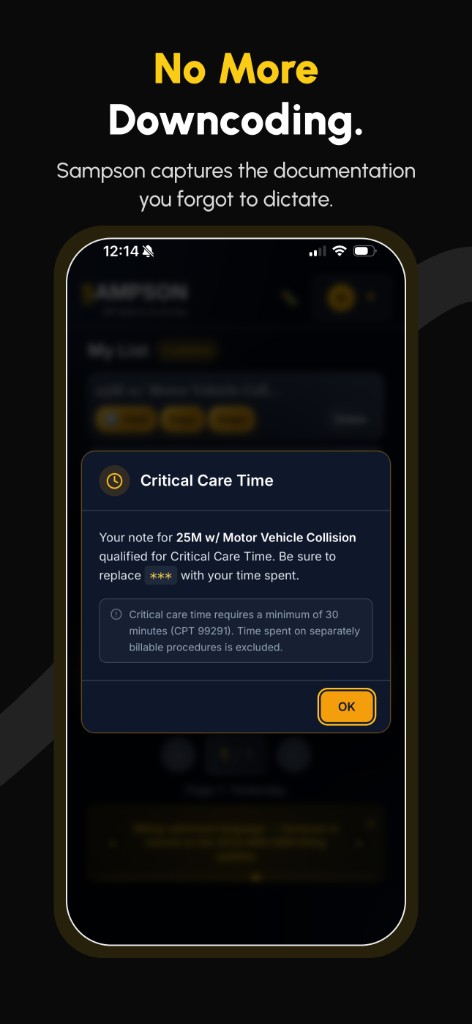
Complex MDM doesn’t vanish into a Level 3 because you were too busy to dictate the whole thing. Built around 2023 E/M billing updates. Stop leaving money on the table.
You’re covered
Did you really fully defend not imaging that last back pain patient? Or did you just write “no red flags” and sign it because you should have been home by now? Three years from now, your defense is locked in — why a CT wasn’t indicated, why discharge was appropriate, and yes, the patient was informed of that incidental finding — it’s right there in their DC instructions.
This is what Sampson actually writes.
One MDM from a real dictation. Billing language, risk defense, consultants, differential—captured without you dictating a novel.
[1]Documents independent historian credit under 2023 E/M guidelines
[3]Captures independent interpretation of tests to optimize billing credit
[5]High-risk medication — captures risk category credit
[7]Timestamped consult — billable + medicolegal
65-year-old male with hypertension and hyperlipidemia presents with chest pain. Reports chest pain that started while at rest, worsened with exertion, and associated with nausea and diaphoresis. History obtained from EMS who served as an independent historian[1] who gave full dose aspirin and nitroglycerin and noted stable vitals in the field.
Differential diagnosis includes acute coronary syndrome, aortic dissection, pulmonary embolism, and pneumothorax, all of which pose a threat to life or bodily function[2], as well as musculoskeletal chest wall pain and gastroesophageal reflux disease.
I independently interpreted[3] the EKG as normal sinus rhythm with anterolateral ST depressions and no STEMI criteria. Troponin was 251 and uptrended to 321. CBC, CMP, and UA without clinically significant acute findings. I independently interpreted the CXR as no acute findings; radiologist later agreed. I reviewed outpatient echocardiogram dated 08/13/2025 showing EF 55–60%, which informed ED management.[4] Patient started on a heparin infusion for NSTEMI, which is a high-risk medication requiring intensive monitoring[5]. HEART score is 7. Wells PE score is 0.[6] Discussed with hospitalist Dr. Robinson at 06:32 PM[7]; patient will be admitted for cardiac workup. Discussed with cardiologist Dr. Smith at 05:59 PM who will evaluate the patient and make recommendations. Patient is stable for admission at this time.
At this time, low clinical suspicion for pulmonary embolism based on Wells PE score 0.[8] Low clinical suspicion for pneumothorax based on no respiratory distress and CXR with no acute findings. Low clinical suspicion for aortic dissection based on normal hemodynamics and no ripping/tearing quality. Low clinical suspicion for esophageal rupture based on normal CXR and no history of vomiting/retching.
Admitted to medicine/telemetry.[9]
[2]Billing-optimized differential — optimizes billing credit under complexity of problems addressed
[4]Review of outside records — billing credit for data reviewed
[6]Validated decision tools — medical necessity and risk billing credit
[8]Structured reasoning — automatically defends against dangerous and less likely diagnoses
[9]Clear disposition — closes the clinical loop
Documents independent historian credit under 2023 E/M guidelines
Billing-optimized differential — optimizes billing credit under complexity of problems addressed
Captures independent interpretation of tests to optimize billing credit
Review of outside records — billing credit for data reviewed
High-risk medication — captures risk category credit
Validated decision tools — medical necessity and risk billing credit
Timestamped consult — billable + medicolegal
Structured reasoning — automatically defends against dangerous and less likely diagnoses
Clear disposition — closes the clinical loop
No investors. No corporate overlords. No sketchy data practices.
Just fed-up EM docs.
Sampson isn't a clinic scribe with an EM template bolted on. Sampson is built from the ground up for emergency medicine by board-certified EM attendings who use it every shift — no VC funding, no private equity, and your data never gets sold.
Built between patients, on real shifts, across an academic county Level 1 trauma center, high-volume community EDs, freestanding EDs, and small rural EDs. Different shops, same reality — and every off-the-shelf option failed in all of them.
Your data stays yours. We don't sell it, we don't train on it without your explicit permission, and we're not in the business of building our own replacement. We built a documentation tool, not a data product masquerading as one.
Questions. Fair.
Sampson uses ambient AI to turn what you say into a note. What it doesn't do is practice medicine. You make the clinical decisions — Sampson documents and defends them.
Sampson is fully HIPAA compliant. Encrypted in transit and at rest, BAA in place, the whole nine. We don't mess around with patient data.
Sampson is not a data product masquerading as a documentation tool. We don't sell your data to anyone — not notes, not transcripts, not even de-identified data. We don't use it to train our models unless you specifically give us permission (everyone is opted out by default). The data we hold onto long term is the bare minimum for HIPAA compliance and to run the service.
Sampson works with all of them. Sampson generates the note — you paste it wherever you need it. Epic, Cerner (Oracle Health), Meditech, CPSI, eClinicalWorks, T-System—whatever your shop runs.
Yes. Attestation mode is built in — dictate your supervision of multiple residents'/APPs' patients in one pass and Sampson produces a separate, complete attestation for each. Sampson was built at an academic county ED, so supervisory workflows weren't an afterthought.
No. Talk to Sampson the way you'd talk to a friendly colleague. A consult that didn't go well. A history you're taking with a grain of salt. Say it casually — Sampson is designed to turn that into professional chart language.
Tell Sampson what to keep, what to leave out, and what to correct. The patient next door said chest pain when yours doesn't have it. Someone reports 10/10 pain while laughing at a video on their phone. Sampson isn't a patient-facing clinical tool — it's built for clinicians. The note should reflect your clinical judgment and the information you choose to include, not every remark from a noisy room.
Sampson has built-in confidence detection — it automatically flags things it thought it heard, things it replaced, and things it wasn't sure about. It's designed to omit rather than invent — if something wasn't clearly part of the encounter, it doesn't end up in the note. That said, it's on you to review the note — what ultimately ends up in the chart is obviously your final responsibility. The good news is that Sampson's output is consistent and structured enough that review is a quick scan, not a deep dive.
It's completely free to beta testers right now. We're still finalizing long-term pricing.
Sampson doesn't integrate with or connect to your EHR — there's nothing for IT to install. You record on your phone during the encounter, then open Sampson on your work desktop, copy the note, and paste it into the chart. From your EHR's perspective, you wrote the note.
Because Sampson is built by EM attendings who use it every shift. Our notes. Our licenses. Our RVUs. We are Sampson's harshest critics.
Contact us
Send a note and we'll get back to you by email.